|
He who digs a pit will fall into it, And he who rolls a stone, it will come back on him. Proverbs 26:27
This is not a proverb that explains why bad things happen to Wylie Coyote - even though at first glance it might. It is actually about those who plan to do evil to others. Those who set traps to catch others and have bad things happen to them are warned in this proverb that what they do will eventually happen to them. Let's take a look at what this means - and also see an example or two. Those who dig a pit do so to catch someone in it. In biblical times people would dig pits and cover them for the purpose of catching more than just animals who would fall into them. These pits would be dug and covered with camouflage as well as wetted down on the sides so that whoever was caught in them would not have opportunity to escape. Those who caught the person would then either take them captive as a slave - or kill the one who fell into the pit. The reason a stone would be rolled is to be put on a steep hill so that it could then be rolled down to kill or badly injure someone who was coming through the valley. This was a tactic of thieves who wanted to steal what travellers would have as they went through valleys and along roads that were next to hilly or mountainous areas. The idea with a pit or with a stone was to injure or kill someone for evil purposes. God warns that those who do such things will fall into a pit themselves. God also warns that the stone that is rolled with come back on them. This is not a reference to an actual pit or an actual stone rolling on them - but was a warning that God was going to hold them responsible for their wicked actions. A good example of this would be the story of Joseph and his brothers. The brothers threw Joseph into a pit with the original intention of killing him because of their jealous hatred of him. Joseph and his stinking varicolored coat reminded them every day that their father loved him more than them - so why not teach the little runt a lesson. Of course killing your brother is a little intense. In the end they decided just to sell him into lifelong slavery (their sibling rivalry was way more intense that what I remember with my brothers). They covered their tracks by dipping the hated coat in blood and telling their father that a wild animal killed Joseph. But the pit they dug - and the rock they rolled was going to come back on them one day. The first "pit-experience" was when their father almost died from grief. Then there was the famine that came and caused them to have to go to Egypt where they had to ask for food from . . . wait for it . . . their snotty little brother who was now the second ruler of Egypt. What was very good for them was that their brother had far more mercy on them in their pit that they had on him when he was in theirs. They had rolled their stone on him - but he refused to roll his on them. He chose forgiveness rather than revenge. The varied pits that you can fall into are as numerous as the ones you dig for others. It is amazing as I grow older to see all the various pits that people have fallen into after they've dug ones for someone else. It is a fact of life that what goes around comes around. That is the simple, one-sentence way to define this particular proverb. I just hope that we all remember that the next time we grab our shovels and start digging for someone else.
1 Comment
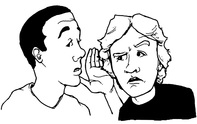 The north wind brings forth rain, And a backbiting tongue, an angry countenance. Proverbs 25:23
A wise man does not participate in backbiting or gossip. It is a very destructive thing when we do. Therefore a wise man does everything he can to make it very clear that he will not participate in it. That is what God wants to give us wisdom about in today's proverb of the day. This particular proverb creates a problem for us - in that in Israel the north wind does not bring rain. It is the southeastern winds that do that task. Some think that because of this that this proverb may be one Solomon learned from Egypt, because that particular area does have rain originate out of the north wind. Regardless of which geographic region this proverb originated, the fact is that when the wind blew from the north in this region, it brought with it clouds and rain. The one thing that is accepted by just about every commentator is that this cloudiness and stormy weather promised by the north wind is compared to the stormy, angry countenance that should be given to someone who is about to begin gossiping about someone else. The phrase, "a backbiting tongue" comes from the Hebrew word "seter" which means a covering or a secret hiding place. The idea it brings with it is that of secrecy. The problem with this word is that the one speaking is wanting secrecy only from one person - the one about whom he is talking. He is more than willing to talk about them - he just is not willing to talk TO them. This is the problem with gossip and backbiting (or secret talking). The one doint it is usually unwilling to make his complaint public where the other person can either answer or repent and initiate change. No such grace is extended to the focus of the gossip. The desire is not to help them - or to see them delivered from some sin or fault. The desire is to destroy the person. They are denigrated in the eyes of others. Since this is done behind their back - there is no way they can change. On top of all this - the people who hear about the gossiped-one's faults - are usually being turned against him. Thus the one who is the subject of the gossip is doubly damaged. First he is not being confronted about whatever sin led to the gossip - and second, he is being isolated by the gossip. In the end he or she is hated and shunned - which is what the gossip had as their goal in the first place. Most gossip is either started or continued due to a bitterness or lack of forgiveness of the one about whom they are gossipping. That is why this is such a wicked sin. How do you stop a gossip from pouring their poison into your soul? This passage tells you how. Just like a cold north wind brought clouds and rain into the area from which this proverb arose, so also an angry countenance brings a stop to the gossip and backbiting. This is not a brief glance, or a telling look. The word here in the Hebrew is "zaam" and it means to be indignant and enraged. The root word literally means to "foam at the mouth." So this is no quick glance - it is a look that says, "Stop this now!" That is how to do it. There is no real gracious way to deal with a gossip - except to be indignant that they would include you in their wicked work. That is accomplished by giving them a very angry look that says in effect, "Not with me, bro!" A wise man is a peacemaker - not a gossip. His desire is healing and grace - not to gather a group against someone with whom he has a gripe. Such things are to be dealt with face to face with the one with whom you have the problem. Oh, how much would be healed in the church this way. Oh, the damage that would be prevented by walking in such grace and loving truth with each other. But because such wisdom is ignored, relationships are destroyed, friendships and ended, and even churches are split. That is why whenever gossip comes to knock at the door of your soul, you should answer with an angry, enraged countenance that says, "No way! Don't bring that junk in here!" Do not associate with a man given to anger; Or go with a hot-tempered man, Or you will learn his ways And find a snare for yourself. Proverbs 22:24-25
Having angry friends will eventually train you to be an angry man. That is the gist of today's proverb. The statement, "do not associate" speaks of friendship. It speaks of those with whom we have close relationships. We are to avoid thos who are "given to anger" - meaning those who give themselves over to their anger. They do not control their anger - their anger controls them. If we wonder what a man given to anger looks like, we receive a little better description of him immediately afterward. He is referred to as a "hot-tempered man." The Hebrew here is very descriptive - referring to this man as a "hot-headed" man. The picture is of the angry man who becomes red in the face as he blows his top. We've all seen that before and need no further description to know about what the Bible is speaking. The reason why we are not to have a friend who has serious anger problems is because of the principle of friendship. Here is the old west version of this principle Those we hang with may be the reason we are being hanged. In modern terms this principle is simply this. We will learn the behavior of our friends. The Bible puts it this way, "Do not be deceived, bad company corrupts good morals." (1 Corinthians 15:33) Therefore if we become close friends with a red-faced man - we will eventually be like him. We will learn his ways. The end of this is even more problematic. We will, through this situation, find a snare for ourselves. The snare mentioned here is that we ourselves will become a "red-faced man." The anger that is in our close associate - will begin to manifest itself in our lives. Just a few days ago I was listening to a message by pastor Ken Graves and he made a devastatingly true comment about those who say that they have an "anger problem." Pastor Graves stated, "You don't have an anger problem, you have a self-love problem." That is a crushing thing to grasp when God first reveals it to you. Of course, this is only true because we pamper ourselves and justify our anger. We don't like it when people treat us badly - because we love ourselves so dearly. People should realize that we are worthy of far better treatment. If they just knew how truly awesome we are - like we know ourselves to be awesome - they'd treat us much better. Therefore we are justified in our anger - because a truly awesome person is being wronged! There, dear brothers, is the snare. The snare is not anger itself - but the self-love that perpetuates it. God commands us to be angry - but not sin - and not to let the sun go down on our anger. There are truly righteous reasons to be angry (and none of them involve a love of self). Jesus was angry when He cleansed the temple courts. His anger was a righteous indignation that His Father's glory was being denigrated by making the place of worship and prayer a den of thieves. But other times Jesus was insulted, called terrible names, and even beaten and crucified - and did not react angrily. Maybe we should associate with Him and learn His ways? The Word tells us that if we take His yoke upon us and learn of His ways - we will find peace for our souls. God's promise is that as we behold as in a mirror the glory of the Lord - we will be changed into that same image from glory to glory. Our character will truly reflect the glory of Jesus temperment. We will be changed from "red-faced" men to being "glory-faced' men. Do not say, “I will repay evil”; Wait for the Lord, and He will save you. Proverbs 20:22
Revenge is something that is very dangerous. We are told by today's proverb not to say that we ourselves will repay the evil done to us. Instead we are to wait for the Lord to be the One who saves us. There are two interesting examples of this - and Solomon was well aware of both of them. These two examples were Saul and David. They were the opposite ends of this issue of taking our own vengeance and repaying the evil done to us. They are also the difference between blessing and destruction. Saul started out his career being wise in this way. When he became king some scoffed at him - and did not bring him any kind of present - on a day when presents were in order. Shortly after this God allowed a situation where Saul proved his worth - and showed that he indeed was fit and called to be king. When some wanted to bring vengeance on these men who rebuffed Solomon, his response was wise. He said that no one was going to be put to death, because God was gracious and had been good to His people. Thus Solomon allowed the Lord to defend him. But later in life Saul no longer followed the Lord - and began to be rebellious to God's purposes. When he faced a supposed wrong by the priests of the Lord - he reacted violently. Even though the priests acted without any knowledge of any kind of rebellion, Saul had the entire city, men, women, and children put to death. Thus was his reign marred by a continual desire to repay any suspected slight or evil done to him. David was much different. He was wronged repeatedly by Saul and by those who followed him. Yet twice David rejected the opportunity to kill Saul - even when God put the opporutnity to do so. He saw Saul as God's annointed and therefore a man to be honored. His statement to the men with him who desired to put Saul to death was that God would be the One to bring Saul down - but David would not take his own vengeance and repay the evils done to him. David was blessed greatly because of this -a nd God greatly prospered his kingdom. God also blessed David with deliverance after deliverance. Saul . . . he experienced something much diffferent than David. Saul went crazy - he was mad - he lost his mind. This is what happens to us when we think we have to defend ourselves against every slight and every evil done to us. This is a responsibility and a weight on our minds that we cannot carry. Soon the world itself is against us - and everyone and everything is suspect. This will make you lose your mind - just like Saul did. The way to peace is through forgiveness. When we choose to forgive the evils done to us we are blessed. We are adopting the mind and heart of God, Who chose to forgive even though it cost His Son His life to do so. Our minds, when we forgive, are loosed from the constant torture of remembering the wrongs done to us. They are set free from bitterness which will consume our sanity like a dry forest is consumed by a fire driven by dry winds. We are free to give all our slights to God and allow Him Who sits on the throne to determine how to measure out justice and righteousness. Since there is only one ultimate throne in this universe - with only One Who sits upon it - truly, only He can mete out perfect justice. We are liberated from decisions taht are beyond our ability to make. As long as we live in a fallen world there are going to be slights, problems, evils, and injustices that come our way. The wisdom that God offers to us today recognizes these things and gives us a way to deal with them without losing our minds. In the process we are protected from the deeper damage these things can do to us - and we are given the glorious priviledge of forgiving others - which is when we reflect both His character and His glory most. A man of great anger will bear the penalty, For if you rescue him, you will only have to do it again. Proverbs 19:19
The "hot-head" is the focus of this proverb. The man who has a firey disposition and who is in the habit of responding and reacting to what happens to him in angry outbursts. He reacts to things with a rage - in fact what this passage says is that he does so with "great" rage. The word here is "gadol" which means something huge, mamoth, and gargantuan in size. This is not normal anger - it is enraged anger that loses control. What does God say to us about this kind of man? What does the Lord counsel us concerning acting on his behalf? First of all God says that a man who has such huge anger issues is one who will bear the penalty of his actions. The word for penalty is "ownes" and means a fine, penalty, and referred to the fines that were levied against those who violated the law. The picture that is painted for us with the use of this particular word is that of someone whose anger lands them in jail. The enraged explosion they unleash on those who are the target of their anger goes beyond the law - and honestly - is very dangerous. You've heard of the man who in anger goes and gets a gun and returns to the bar or the house - and shoots the person with whom he is angry? That is this person's anger tactic at its worst. To join with this fellow is to risk being put in jail with him - for his actions are going to cross the line - and become illegal. Second, we are told not to continue to resuce this man from his angry outbursts. The problem with him is that he does not learn from his previous outbursts. Instead - he continues in his rage and does it again and again. We are warned that if we rescue him from his outrageous outbursts - we will have to do it again. He does not need to be rescued from the consequences of his actions - instead he needs to face them squarely. Rescuing him from them will only mean that he will do it again. There is a lesson for him that can only be learned from facing stiff penalties for his outrageous behavior. While we are dealing with this proverb, I would like to share something a very wise man taught me about anger - and something that can help those who struggle with it. This godly man said to me the following, "We become angry because we cannot control situations or people. When we cannot control them, we become infuriated at whatever or whoever is not doing what they should be doing - so we can be comfortable and uninterrupted in what WE want to do." This was, at the time, a devastating analysis of anger to me. I considered an angry outburst I had toward one of my children. According to this definition - my anger was not, as I asserted, because my child "made" me angry. My anger arose because my child was not doing what I wanted - and was interrupting what I wanted to be doing. Needless to say I was instantly convicted - repented - and had quite the crow-filled meal as I asked my son to forgive me. Later, when I realized I was not only angry at my son - I was also angry at God, Who in His perfect providence, decided that what I needed was an opportunity to be patient and kind. What I really wanted was a trial and testing free zone about me at all times. This led to a second meal of abundant crow as I sought God's forgiveness for my pride and arrogance in wanting Him to serve me in the providence He provided for me. Anger - outbursts of anger - are a dangerous thing. We need to bear the penalty of these things so that we see them for what they are - manifestations of our pride and desire to control everything in our lives. We need to see them as a reminded that we DO NOT CONTROL our own lives. Angry outbursts are a warning sign to us that we are wanting the world around us to serve us at all times. This will NOT be the case - and unless we learn this - we will only have more of these times of "great anger" that will cost us dearly. Oh, to learn humility and submission to God and His providence quickly. Those who don't learn this - learn to feast on a whole lot of crow in their lives. A foolish son is a grief to his father And bitterness to her who bore him. Proverbs 17:25
This is a proverb that we've seen before in a slightly different fashion. The only difference is that the word for fool here is the Hebew word "kesiyl" which is a different word than what we've seen in the past. So, with a different word as our guide, lets look at the fool who is a heartbreak to both his mother and father. The word "kesiyl refers to one of several different types of fools mentioned in Scripture. The word study we'll do here will reveal much to us. The first way this word is used is in Ecclesiastes 4:5,13 - where we see that it refers to someone who is unable to deal with the issues of life in successful or practically godly ways. We see that his laziness and unwillingness to be corrected or taught brings about serious problems for him. In Psalm 49:10-11 the psalmist uses the word "stupid" to describe someone who refuses to learn anything. Proverbs 1:32 speaks of a young man who is complacent about his ungodly ways and sees no need to change anything in his life. Psalm 92:6 reveals that he does not understand spiritual issues and Ecclesiastes 2:14 shows us that he chooses to walk in darkness and see the problems he has. We get the idea that this son is a young man who refuses to learn or listen to anyone other than himself. He is lazy and undisciplined - and that is most clearly seen in that he refuses to do what is necessary to be guided by a person, a book, or any kind of mentor. In the end this young man's ignorance is embraced as he thinks that nothing is wrong - and his life needs no change. As a result he walks in darkness and doesn't even know it. His spiritual ignorance is astounding - yet the young man sees no connection between his problems and his unwillingness to listen and learn from anyone. The parents of such a child are to be pitied. The father is filled with grief. The word for this is "kaas" which means to be angry and provoked. The same word is used for God's anger toward those who paractice idolatry. For the father of this young person - his anger and vexation is due to the fact that his child worships himself and his own mind rather than God. The only person he listens too and values is himself. His mother if filled with a sense of bitterness. It is very difficult for her to process the choices and actions of such a child. The word in the Hebrew speaks of a harsh reality that is the opposite of something pleasant. Her sorrow and pain is sharp as she tries to rear a child who values nothing of what is offered to him, unless he already has thought of it himself. This young person's attitude mirrors that of a lost person without Christ. They are filled with ideas and thoughts that only validate their own thinking. They love their sin and see no need to stop it. They are grossly ignorant and stupid - valuing only their own thinking and reasoning which is fatally flawed by the fall of man into sin. There is no hope for such a young man or woman were it not for the grace and mercy of God. Fortunately for such people God pursues us by His infinite mercy. He brings us to a knowledge of our true condition and the sheer massive gargantuan size of our stupidity. He then draws us and opens our eyes to our condition - offering grace to change us from the inside out. For the parent of such a rebellious, ignorant child - there is only one hope. That hope is to fall on one's knees and cry out to God. Pray that He will open their eyes to their stupidity and deadness of heart - and then change them by the wonderful operation of His grace! There is little else one can do outside this. Thanks be to God that He delights in changing stupid young people into wise saints by His saving grace. Going Deeper in Your Understanding about Anger and Quick-tempered Responses Proverbs 14:291/12/2012 He who is slow to anger has great understanding, But he who is quick-tempered exalts folly. Proverbs 14:29
We see throughout the book of Proverbs that a quick temper is a negative thing in a person's life. It can get us into a world of trouble. Here we read that the man who is quick-tempered exalts folly. Giving in to anger, resentment, and bitterness in our lives only exalts folly. The idea here expressed is that it is the "unthinking" and "unreasoning" way to live our lives. Anyone can become frustrated or angry and then give in to having a blowout that involves a temper flaring up and expressing itself in hurtful words or actions. That exalts stupidity and living foolishly. What then, can keep us from exalting folly by being quick-tempered? The Bible says that someone who is slow to anger has great understanding. The word for understanding here is "tebunah" and it means to have both understanding and insight. It is taking both knowledge and wisdom and applying it in a way that helps us look into our anger and examine it before reacting. That indeed is wisdom. We need to ask ourselves the question, "Why am I so angry about this?" Looking into our reaction often will make us ask deeper questions and deal on a deeper level than just saying, "I'm so angry about this!" When we probe our anger we need to be ready to run into personal issues that exist on the inside of our lives. I will never forget the shock it was to me when an older, wiser man told me the reason I got so angry with my children was because of my pride. On the inside I wanted to snap back that it was their disobedience that was making me mad - not something wrong with me. In no way was this man saying I should not have disciplined them for being disobedient and rebellious - he was only saying that I needed to see why at times I felt out of control while doing it. His wise counsel was that my pride and anger came from a desire to control my children - so they would never disobey. My reason behind this thought was that my kids made me look bad as a parent when they disobeyed - and that made me angry. A wise parent would know that children are GOING to be disobedient because they are sons of Adam. The fall of man will ensure that every child will be disobedient and rebellious in some way. Therefore having a disobedient child does not mean you are a bad parent. A parent who is failing in their role is one who does not discipline his or her child for their disobedience. I was failing not because I was disciplining my child - but becasue at times I was doing so in anger. My anger was foolish because I was expecting my child never to disobey - so I would look good in other people's eyes. Therefore my anger - when disected with understanding - was due to a couple of foolish things. First, I was not grasping the true nature of a child. Second, I was wanting my child to be good so I would not be bothered with having to interrupt MY DAY with things I did not want to do. Third, the reason I wanted a "good child" was so that my glory could be advanced. When looking at my quick-tempered responses suddenly I was a little horrified (understatement of the year) at their root. It was pride! Therefore wisdom applied - understanding deepened - and a willingness to have the Holy Spirit probe deeper into my motivations yielded repentance . . . and it yielded an ability over time to be much slower to anger. Let me encourage any of you who are struggling with being quick-tempered. Take the time to submit yourself to the Holy Spirit. Allow Him to take you deeper into your angry responses in order to look at them and see them at the level of your heart motivations. He will walk you through this process and will help you to understand why you have a quick-temper at times. I will not say that this is pleasant - but God will do it with a view to repentance and restoration. He will do so with great grace and comfort - as well as a little heart surgery that will help you to become someone who is far more slow to anger. You will find that His grace and His gospel will be enough to turn from quick-tempered foolishness to patient love and understanding. |
 Proverb a DayEach day, we'll take a look at a verse from the chapter of Proverbs for the day. Our hope is to gain wisdom each day - and from that wisdom - to have understanding to make godly decisions in the throes of everyday life. 
Thank you for visiting our website! Everything on this site is offered for free. If, however, you would like to make a donation to help pay for its continued presence on the internet, you can do that by clicking here. The only thing we ask is that you give first to the local church you attend. Thank you!
Archives
August 2018

|
 RSS Feed